Why?
Language models are widely used for different Natural Language Processing tasks while suffering from a
lack of
personalization. Personalization can be achieved by, e.g., fine-tuning the model on training data that is created by the user (e.g., social
media posts). Previous work shows that the acquisition of such data can be challenging. Instead of adapting the model's parameters,
we suggest
selecting a model that matches the user's mental model of different thematic concepts in language.
How?
In this paper, we attempt to
capture individual language understanding of users. In this process, two challenges have to be considered. First, we
need to counteract disengagement since the task of communicating one's language understanding typically encompasses repetitive
and time-consuming actions. Second, we need to enable users to externalize their mental models in different contexts, considering that
language use changes depending on the environment. In this paper, we integrate
methods of gamification into a visual analytics (VA)
workflow to engage users in sharing their knowledge within various contexts. In particular, we contribute the design of a gameful VA
playground called Concept Universe. During the four-phased game, the users build personalized concept descriptions by explaining
given concept names through representative keywords. Based on their performance, the system reacts with constant visual, verbal,
and auditory feedback.
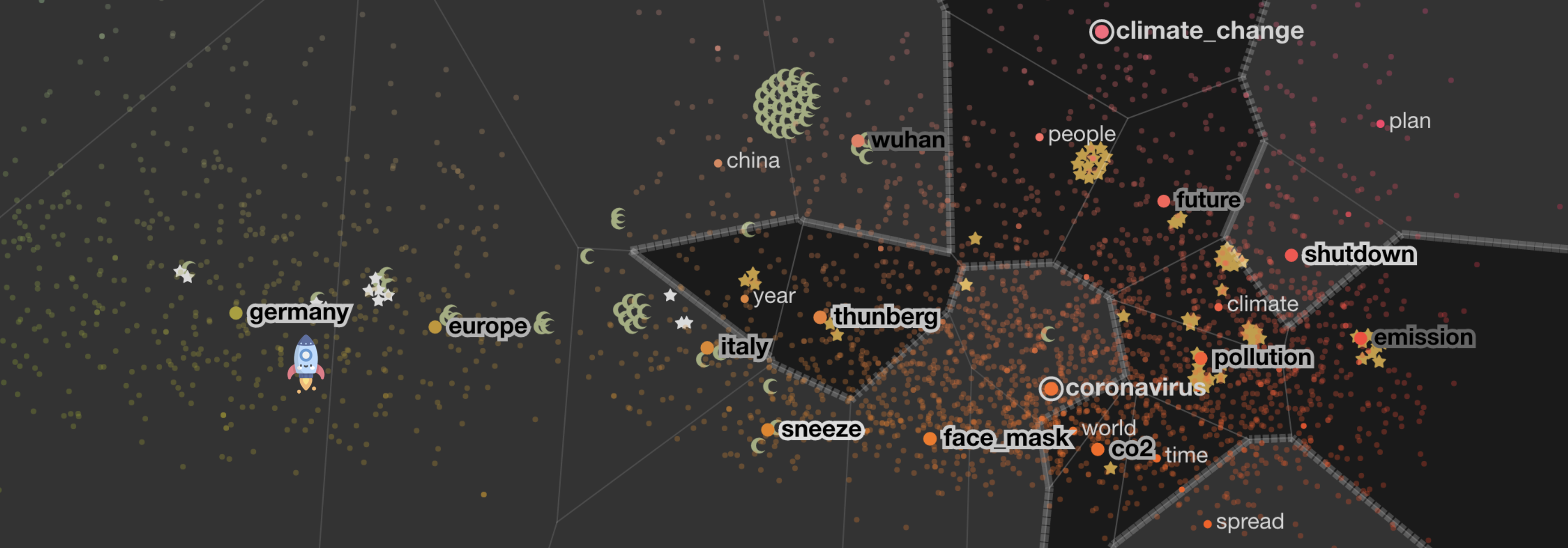
Design
- We use the linguistic model for processing purposes to measure the user's performance and build virtual players.
- The goal of the visual interface is three-fold: (1) to enable the users to describe concept names by entering representative keywords;
(2) to measure users' input using multiple quality metrics and provide feedback on the entered keyword descriptiveness;
(3) to display the entered keyword relatedness to the optimal linguistic model.
- As the effectiveness of the applied game dynamics is user-dependent (i.e., people have different preferences), we
integrated six game elements into the interface. With these elements, we aim to engage users while they perform the task. Furthermore, the exploration, challenge,
competition, and collaboration dynamics are implemented as separate game levels that enables us to simulate and evaluate different contexts in which the language is used.
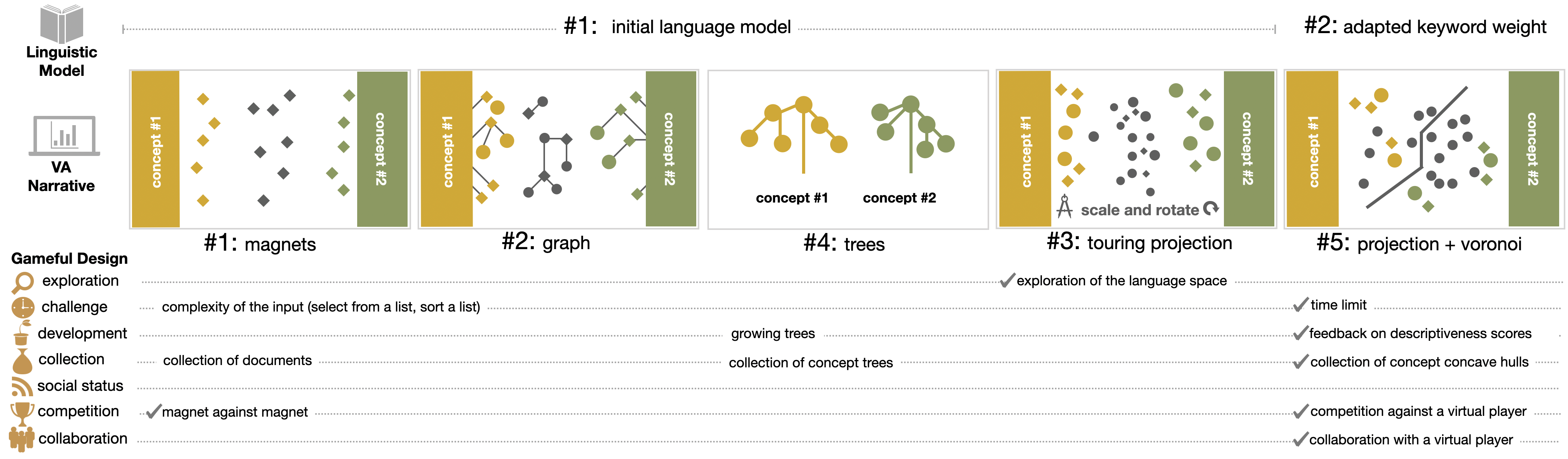
The linguistic model was designed in two iterations and
was settled after the final implementation of the VA narrative. The VA narrative took five iterations; during the design
process, we considered multiple visualization techniques for representing the language space, such as a graph, tree, as well
as 2D projection layout. The game elements were reviewed according to the particular VA narrative. The checkmark-labeled
game elements are implemented in the current design of the interface.
 Contribution
